- LET'S PLAN YOUR SAFARI
- +256 200 921 002
- +256 793 194 703
- info@rwandagorillatrekkingtours.com

Gorilla Trekking in Uganda Starting from Kigali
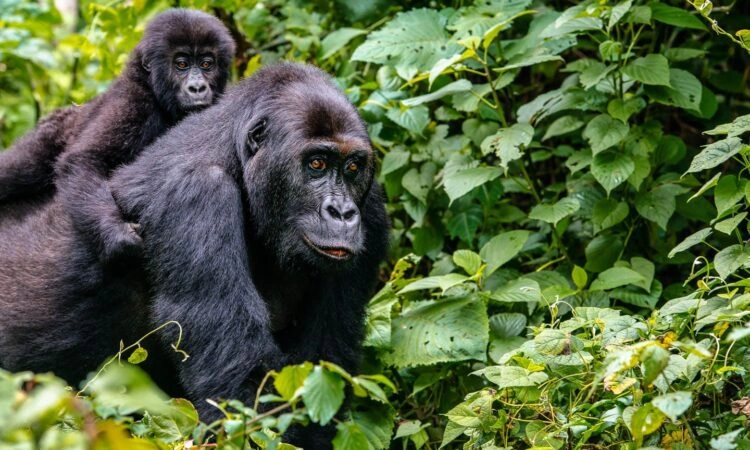
Gorilla Trekking in Uganda Starting from Kigali. Many travellers land in Kigali, see gorillas in Rwanda, then cross the border to trek gorillas in Uganda, or skip Rwanda’s park and go straight from the airport to Uganda’s forests. Kigali International Airport is a practical gateway to south-western Uganda, where Bwindi Impenetrable National Park and Mgahinga Gorilla National Park protect mountain gorillas. Both countries use separate permit systems, separate parks and different visa rules, so the trip needs planning, but it is a well-worn route.
The key facts are these. Uganda’s Bwindi Impenetrable National Park has four gorilla sectors, called Buhoma, Ruhija, Rushaga and Nkuringo, and the Uganda Wildlife Authority (UWA) says the park shelters approximately 459 mountain gorillas, almost half of the world’s remaining population. You can read the park profile on the UWA Bwindi page. Mgahinga Gorilla National Park, on the Rwanda border, is much smaller, and the UWA lists one habituated transboundary group there. From Kigali you reach these parks by road through one of two main border crossings, which we explain below.
At Rwanda Gorilla Trekking Tours we plan both sides of the frontier. If you want to see our range of options, start with our Rwanda and Uganda gorilla safaris or our overview of Uganda gorilla trekking.
What This Guide Covers
This guide explains why Kigali is a good starting point, which routes lead to Uganda’s gorilla parks, what sample itineraries look like, how Uganda’s permits work and how to combine them with a Rwanda permit. It also covers the border crossing, visas and documents, how Uganda compares with Rwanda, what the trip costs, how to prepare and how to extend the trip. Where a fact comes from an official body such as UWA, Uganda’s immigration service, the Rwanda Development Board (RDB) or Visit Rwanda, we link to it so that you can check the current details. Rules and prices change, so please confirm them before you pay. You can also visit our home page or ask us a question on the contact page.
Why Start Your Uganda Gorilla Trek in Kigali?
Kigali is convenient for several reasons. The first is access: Kigali International Airport is the main entry point for Rwanda. The second is that south-western Uganda lies just across the border. A Rwandan car-rental company’s border guide reports that the Gatuna crossing is about 80 kilometres and roughly two hours from Kigali, and that the Cyanika crossing is about three hours away via Musanze. Those figures come from a private operator, so treat them as estimates and confirm timings with your driver.
The third reason is flexibility. Starting in Kigali lets you see gorillas in both countries on one journey, compare the two experiences and use the capital for a city stop. It also suits open-jaw itineraries, where you fly into Kigali and out of a different airport in Uganda, so that you do not backtrack. If you would like to see how a mixed route works, see our Rwanda safari tours page.
Two Countries, Two Permit Systems
Remember that each country manages its own gorillas. Rwanda’s permits are issued by RDB for Volcanoes National Park, and Uganda’s are issued by UWA for Bwindi and Mgahinga. A permit for one country does not work in the other, and the prices and rules are set separately. RDB’s mountain gorilla tracking page covers the Rwandan side, and the UWA gorilla tracking page covers Uganda.
Three Ways to Use Kigali as Your Base
The first is to fly into Kigali, trek in Rwanda first and then travel to Uganda. The second is to skip Rwanda’s park and drive directly from Kigali to Uganda’s gorilla sectors. The third is to base yourself in Kigali only for arrival and departure, and to use a private vehicle for the whole loop through south-western Uganda. Which one is best depends on your budget, your fitness and how many days you have. Our page on Volcanoes National Park shows what you would be visiting on the Rwandan side, and you can request a route through the booking page.
Routes From Kigali to Uganda’s Gorilla Parks
There are two main land borders between Rwanda and south-western Uganda, and the one you choose depends on which gorilla sector you have a permit for. Distances and times below come from a mix of official park information and private operators, so treat the private figures as estimates.
| Route | Border crossing | Best for | Approximate figures |
|---|---|---|---|
| Kigali to Kabale | Gatuna (Rwanda) to Katuna (Uganda) | Ruhija and Buhoma sectors, Kabale, Lake Bunyonyi | About 80 km and two hours from Kigali to the border, according to a car-rental operator; Kigali to Kabale is reported at about 140 km and three to four hours by another operator |
| Kigali to Kisoro | Cyanika (Rwanda) to Kyanika (Uganda), via Musanze | Nkuringo and Rushaga sectors, Mgahinga | About 119 km and three hours to the border according to the same car-rental operator; the border is not open 24 hours |
The Gatuna and Katuna Route to Kabale
The northern route runs from Kigali to the Gatuna border and on to Kabale, a town in Uganda’s Kigezi region. The car-rental guide says the crossing is open 24 hours and is set up as a one-stop border post, where exit and entry procedures are completed at one location. From Kabale, the UWA’s Bwindi page gives approximate figures for onward travel, including around 95 kilometres and four hours to the Ruhija and Buhoma area and around 105 kilometres and four hours over mountainous murram road to Nkuringo. Roads in the highlands can be slow, so plan for a full travel day.
The Cyanika Route to Kisoro
The Cyanika route is popular with travellers who have just finished a Volcanoes National Park trek, because it leaves from the volcano region. One tour listing crosses at Cyanika on the day after the Rwanda trek and heads for Bwindi’s southern sectors, as shown in a 5-day Rwanda and Uganda gorilla itinerary. The car-rental guide says Cyanika is open from about 6am to 10pm and not around the clock, so leave the Rwandan side early if you are combining a trek with the crossing. UWA gives a distance of about 35 kilometres and 1 to 1.5 hours from Kisoro to Nkuringo, which is why the southern sectors are convenient from this side.
Which Gorilla Sector Should You Choose?
UWA lists four sectors in Bwindi. Buhoma is the northern headquarters, Ruhija is a separate sector, and Rushaga and Nkuringo are the southern sectors. Mgahinga sits beside the volcano range and the Rwandan border. If you plan to arrive from Kigali by Cyanika, the southern sectors and Mgahinga are closest. If you cross at Gatuna and travel through Kabale, Ruhija or Buhoma may suit your route. Your choice of sector is also tied to permit availability, so book the permit first and then plan the road. For help, use our Uganda gorilla trekking page or contact us through the contact page.
Sample Itineraries for Gorilla Trekking in Uganda From Kigali
The outlines below show how a trip can be structured. They are examples for planning, not fixed products, and the timings depend on your permit date, your sector and the road. We confirm the details for your dates when you send a request.
| Trip | Outline |
|---|---|
| 3 days, Uganda only (tight) | Day 1: drive from Kigali across the border to south-western Uganda. Day 2: gorilla trek. Day 3: return to Kigali. |
| 5 days, Rwanda and Uganda | Day 1: Kigali to Volcanoes National Park area. Day 2: gorilla trek in Rwanda. Day 3: cross at Cyanika to Uganda. Day 4: gorilla trek in Bwindi. Day 5: return to Kigali. |
| 6 days, with Kabale or Lake Bunyonyi | The 5-day plan with an extra night in the Kabale region, entering or leaving through Gatuna. |
The five-day pattern matches a published itinerary on volcanoesnationalpark.org, where gorilla trekking takes place on day two in Rwanda and day four in Uganda, with a border crossing at Cyanika on day three. See that Rwanda and Uganda itinerary for an example of how an operator arranges it.
The 3 Day Uganda-Only Trip
A three-day trip is the shortest way to trek in Uganda from Kigali, and it is tight. Day one is mostly driving, day two is the trek and day three is the return, so any delay at the border or on the road affects your schedule. It is possible for fit travellers with a permit in a southern sector, but it leaves little margin, and we advise adding a night if you can. Ask us for a realistic timetable through our contact page.
The 5 Day Rwanda and Uganda Trip
Five days is the classic plan for two gorilla treks. You spend day one travelling to the volcano region, day two trekking in Rwanda, day three crossing the border and travelling to Bwindi, day four trekking in Uganda and day five returning to Kigali. It lets you compare the two experiences, and you can read more about this combination on our Rwanda and Uganda gorilla safaris page. If you want to trek only once, look at shorter options such as our 3 days Rwanda gorilla safari and 4 days Rwanda gorilla safari.
The 6 Day Trip With Kabale and Lake Bunyonyi
Add a night in the Kabale region if you want to rest, take in the scenery and split the driving. Lake Bunyonyi is a popular stop in this area, as described on Visit Uganda’s Lake Bunyonyi page. Entering or leaving through Gatuna works well with this plan because Kabale is the natural gateway.
Uganda Gorilla Permit Price and How to Book
Uganda’s gorilla permits are sold under the UWA conservation tariff. The tariff for July 2024 to June 2026 lists a gorilla permit at US$800 for foreign non-residents, US$700 for foreign residents and UGX 300,000 for East African citizens, and it states that these rates include the guide fee, the park entrance fee for the day and a community development contribution. The same document lists a gorilla habituation experience at US$1,500 for foreign non-residents, US$1,000 for foreign residents and UGX 750,000 for East African citizens. You can see the tariff on the UWA rates page.
That tariff period ended in June 2026, and the UWA rates page refers to tariff changes for 2026 to 2027. Treat US$800 as the previous published price, and confirm the current price with UWA or with us before you budget. You can contact UWA’s reservations team at reservations@wildlife.go.ug, and UWA has also published a public advisory on the purchase of gorilla and chimpanzee permits that explains how permits should be bought.
Rwanda and Uganda Permits Together
If you trek in both countries, you need two permits, one from each authority. RDB’s booking portal lists US$1,500 for foreign visitors on its gorilla tracking page, and it warns that lower categories are promotional and do not apply from June to October 2026. Using the previous Uganda price of US$800, two permits for an international visitor would come to US$2,300 per person before any tour costs. This is arithmetic on past and current published prices, and it will change if UWA’s new tariff differs, so treat it as a planning figure.
Booking Order: Permits First, Then Everything Else
The safest order is to choose your dates, secure both permits, and then confirm transport, accommodation and flights. A permit guide on volcanoesnationalpark.org recommends reserving Rwanda permits at least six months ahead, and the same logic applies to Uganda’s popular sectors. Because sectors and dates differ, ask us to check availability in both countries at once. You can start on our Rwanda gorilla permit page or through the booking page.
Crossing From Rwanda to Uganda: Visas and Documents
The border crossing is simple when your papers are ready and stressful when they are not, so prepare early. Visa rules for Uganda are stricter than Rwanda’s. Uganda’s immigration service states that all visa-prone travellers must apply online at the immigration portal, that no visas are issued on arrival, and that applicants should submit at least ten days before travel, with processing typically taking two to three days. Read the immigration notice on mandatory online visa applications before you book flights.
Uganda Tourist Visa and the East Africa Tourist Visa
There are two main options for a visitor who needs a visa. Uganda’s single-entry tourist visa costs US$50, according to the Uganda immigration tourist visa page, and the approval is valid for 90 days from the day of approval. The alternative is the East Africa Tourist Visa, which costs US$100 and covers Rwanda, Kenya and Uganda. Uganda’s East African Tourist Visa page says it is valid for three months and that the issuing country should be your first point of entry. Rwanda’s immigration service describes the same visa as US$100, valid for 90 days and multiple entry within the three countries, and it repeats that your first entry point must be the country through which you applied. You can read that on Rwanda’s visa information page.
This matters for a Kigali start. If you fly into Kigali first, an East Africa Tourist Visa should be one issued through Rwanda, because the first entry point must match the country of application. If you only want to see Uganda and Rwanda briefly, compare the cost of a Uganda single-entry visa plus Rwanda’s own visa, if you need one, with the cost of the combined visa. Rules and eligibility depend on your nationality and change from time to time, so check the official pages, or ask us to check for you.
Rwanda’s Side of the Story
Visit Rwanda’s immigration page says that citizens of all countries can get a visa on arrival in Rwanda, that African Union, Commonwealth and La Francophonie members receive a free 30-day visa on arrival, that East African Community citizens can stay visa-free for up to six months, and that fees for other nationalities must not exceed US$50 for a single entry. You need to leave and re-enter Rwanda in some itineraries, so ask whether your visa allows multiple entry.
Health Documents and Other Papers
Uganda’s East Africa Tourist Visa page lists a yellow fever vaccination certificate, a passport valid for at least six months, a passport photograph, a return ticket and a travel itinerary among the requirements, and it says applicants report to an immigration office or border post for biometric capture. A Rwandan car-rental operator’s guide also says that a yellow fever certificate is required for travellers entering Uganda from Rwanda. Carry printed copies of your visa approval, permits and itinerary.
Cross-Border Vehicles
If you travel in a rental vehicle, the paperwork is different from a normal transfer. The same car-rental guide lists a letter of authority from the rental company, the vehicle registration, a COMESA Yellow Card and a temporary export permit, and it advises a 4×4 for Uganda’s roads. It reports that the border process takes 30 minutes to one hour when documents are in order. Those details come from a private operator, so confirm requirements with your driver-guide. When you book a guided tour, the operator normally handles the vehicle paperwork, and you handle your personal documents. Ask us for details through our contact page.
Uganda or Rwanda: How the Two Gorilla Treks Compare
Many travellers ask which country is better. Both offer the same species, mountain gorillas, and both limit visits to one hour, so the difference lies in logistics, terrain and cost. The table summarises published facts from the official sources cited in this guide.
| Factor | Rwanda (Volcanoes National Park) | Uganda (Bwindi and Mgahinga) |
|---|---|---|
| Managing authority | Rwanda Development Board (RDB) | Uganda Wildlife Authority (UWA) |
| Time with the gorillas | Up to one hour | One hour of observation |
| Group size | Maximum of eight visitors | Set by UWA rules, so confirm with UWA |
| Trek length | 30 minutes to four hours, per Visit Rwanda | May last two to seven hours, per UWA |
| Permit price | US$1,500 for foreign visitors | US$800 for foreign non-residents under the July 2024 to June 2026 tariff |
| Distance from Kigali | About 104 to 105 km, two to three hours | Border crossing first, then further road travel |
| Number of gorilla sectors | Twelve habituated families, per Visit Rwanda | Bwindi has four sectors, and Mgahinga has one habituated group, per UWA |
Trek Length and Terrain
Rwandan treks range from about 30 minutes to four hours, according to Visit Rwanda, and hikes reach altitudes between 2,500 and 4,000 metres. UWA says that gorilla treks in Uganda may last between two and seven hours, with one hour of observation. Bwindi’s altitude ranges from 1,160 to 2,607 metres, and the forest is steep, so both destinations demand a decent level of fitness. Neither is a strolling safari. Your sector and gorilla family will decide your walk, not the country.
Cost and Value
Rwanda’s permit is significantly higher than Uganda’s previous published permit price, but Rwanda’s park is much closer to Kigali, so you spend less on transport and time. Uganda’s permit was lower under the last published tariff, yet the journey from Kigali involves a border crossing and long road travel. When you compare, add the extra vehicle days and lodging to the permit. Our guide to Rwanda gorilla trekking tours can help you weigh the two.
Which Is Better for You?
Choose Rwanda if you have limited time, if you value simple logistics and if you prefer to start and end in the same country. Choose Uganda if you want a lower permit price than Rwanda’s, a different forest setting or a longer road journey through the southwest. Choose both if you want to compare the experiences. Read our page on Volcanoes National Park for the Rwandan option, and our Uganda gorilla trekking page for Uganda.
What a Kigali to Uganda Gorilla Trip Costs
The cost has fixed parts and flexible parts. The fixed parts are the permits and visas. The flexible parts are transport, lodging, meals and extras. Below is a worked example for one international visitor doing a five-day Rwanda and Uganda trip, using published prices that we cite elsewhere in this guide.
| Fixed cost | Published figure | Source |
|---|---|---|
| Rwanda gorilla permit | US$1,500 | RDB and Visit Rwanda |
| Uganda gorilla permit | US$800 under the July 2024 to June 2026 tariff, to be confirmed for 2026 to 2027 | UWA |
| East Africa Tourist Visa, if you use it | US$100 | Uganda and Rwanda immigration |
| Subtotal of permits and visa | About US$2,400 | Our arithmetic |
That subtotal is only a planning number. It leaves out flights, transport, lodging, meals, tips, insurance and the cost of cross-border vehicle paperwork. A Rwandan car-rental operator reports a COMESA Yellow Card at roughly US$40 to US$50 for 14 days for cross-border vehicles, so ask whether such items are included in your quotation.
What Is Usually Included in the Tour Price
A guided tour normally includes a private vehicle and driver-guide, the accommodation you choose, some or all meals, airport transfers and the arrangement of permits. It normally excludes flights, visas, insurance, tips and personal spending. Ask for a written line-by-line quotation, and check that the permit prices are stated separately, because permits are fixed by RDB and UWA and are the same whichever operator you use.
Ways to Reduce the Cost
Travel with others so that the vehicle and rooms are shared. Choose a mid-range lodge. Keep the itinerary short and focused, or trek in one country only. Consider whether the East Africa Tourist Visa is cheaper than paying for separate visas, if you need both. Confirm the permit categories that apply to you, for example the lower categories that RDB and UWA list for residents and East African citizens, and check whether RDB’s promotional rates are open on your dates. RDB warns that its lower categories do not apply from June to October 2026. For a personalised quote, send your dates through our booking page or the contact page.
Preparing for Gorilla Trekking in Uganda and Rwanda
A trip that combines a long road journey with steep forest walking needs some preparation. Start with your fitness. UWA’s Bwindi visitor factsheet says gorilla tracking in Bwindi can last from a few hours to a whole day depending on where the gorillas move, and its Bwindi page gives an altitude range of 1,160 to 2,607 metres. In Rwanda, Visit Rwanda reports hikes of 30 minutes to four hours. Walk on hills, use stairs and carry a light pack in the weeks before you travel, and break in your boots.
Age, Rules and Health
The minimum age for gorilla tracking is 15 in Rwanda, according to RDB, and the UWA factsheet says Bwindi participants must be aged 15 or over. RDB’s page for Rwanda lists a distance of seven metres, low voices, no flash and a firm rule that sick visitors should not go. A summary of the gorilla trekking rules in Rwanda adds no eating, drinking or smoking near the gorillas and no littering. For Uganda, follow the guidelines and briefing given by UWA rangers on the day. Because you are entering Uganda from Rwanda, bring your yellow fever certificate, as explained above.
What to Pack
Dress in layers. The UWA factsheet gives Bwindi’s temperature range as 7 to 20 degrees Celsius, says June and July are the coldest months and mornings and evenings are cold, and advises warm clothing and wet weather gear because rainfall can reach 2,390 millimetres a year. Visit Rwanda’s park profile recommends sturdy clothing and solid walking shoes, with gaiters and a lightweight waterproof for rain. Pack waterproof hiking boots, long trousers, a long-sleeved shirt, a fleece, a rain jacket, gloves, a hat, sunscreen, insect repellent, water, snacks and a camera with a spare battery. Use soft bags rather than hard cases for a long road trip.
Best Time to Go
Both parks can be visited throughout the year. UWA’s factsheet says Bwindi can be visited at any time, and the seasons guide on volcanoesnationalpark.org lists Rwanda’s dry seasons as June to September and December to February, with rain from March to May and October to November. Dry months make the walking easier, but rain can fall at any time, so pack for it. See the guide to the best time to go gorilla trekking in Rwanda, and ask us about the conditions in Uganda’s sector on your dates.
Trek Day Timing
The UWA factsheet describes registration at 7:30am, a briefing at 8:00am and the start of tracking at 8:30am in Bwindi, while Visit Rwanda says Rwandan visitors gather at Kinigi at 7am. Because that factsheet is an older document and schedules may change, confirm the reporting time for your sector before you book onward transport.
Extend Your Trip: Kabale, Mgahinga and Rwanda’s Parks
A gorilla trek is easier to enjoy when it is part of a longer plan. In Uganda, Mgahinga Gorilla National Park offers gorilla tracking and golden monkey viewing, Batwa guide tours and volcano hikes, according to the UWA Mgahinga page. Around Kabale, Lake Bunyonyi is a natural place to rest. The car-rental border guide adds that the Gatuna route also suits travellers heading to Queen Elizabeth National Park.
On the Rwandan side, add golden monkey tracking and read about the Dian Fossey hike. See our golden monkey tracking in Rwanda, Nyungwe National Park, Akagera National Park and Kigali city tour pages for options you can add before or after the border trip.
Mistakes to Avoid When Combining Rwanda and Uganda
The first mistake is leaving visas to the last minute, because Uganda does not issue visas on arrival to visa-prone travellers. The second is buying the wrong East Africa Tourist Visa for your route, since the first entry must be the country of application. The third is booking flights before the permits are confirmed. The fourth is underestimating road time, especially on highland roads, and the fifth is arriving at Cyanika late, since it is not open around the clock. Also remember your yellow fever certificate.
Frequently Asked Questions About Gorilla Trekking in Uganda From Kigali
Can I Trek Gorillas in Uganda Starting From Kigali?
Yes. Fly into Kigali, cross by road at Gatuna or Cyanika and trek in Bwindi or Mgahinga. Plan for visas, permits and a long road day.
Which Border Is Better: Gatuna or Cyanika?
Gatuna, which is about 80 kilometres from Kigali and open 24 hours according to one car-rental guide, suits Kabale and Bwindi’s northern and eastern sectors. Cyanika suits Mgahinga and Bwindi’s southern sectors and is not open 24 hours.
How Much Is the Uganda Gorilla Permit?
The UWA tariff for July 2024 to June 2026 lists US$800 for foreign non-residents. Confirm the current price on the UWA rates page because a new tariff period has begun.
Do I Need a Visa for Uganda?
Most travellers who need a visa must apply online in advance, because Uganda issues no visas on arrival to visa-prone travellers. Check Uganda’s immigration service and Rwanda’s immigration service for your nationality.
Can I Do It in Three Days?
It is possible but tight, with one day of driving in, a trek day and one day back. Add a night if you can.
Book Your Uganda Gorilla Trek From Kigali
Gorilla trekking in Uganda starting from Kigali combines two of Africa’s best forest experiences with a single arrival airport. Choose your permit dates first, sort out your visas, decide on the border and sector, and let an experienced team handle the road. Explore our Rwanda and Uganda gorilla safaris, read the blog, learn more about our team and send your dates through the contact page or the booking page.