- LET'S PLAN YOUR SAFARI
- +256 200 921 002
- +256 793 194 703
- info@rwandagorillatrekkingtours.com

Short Gorilla Tours in Rwanda with Wildlife
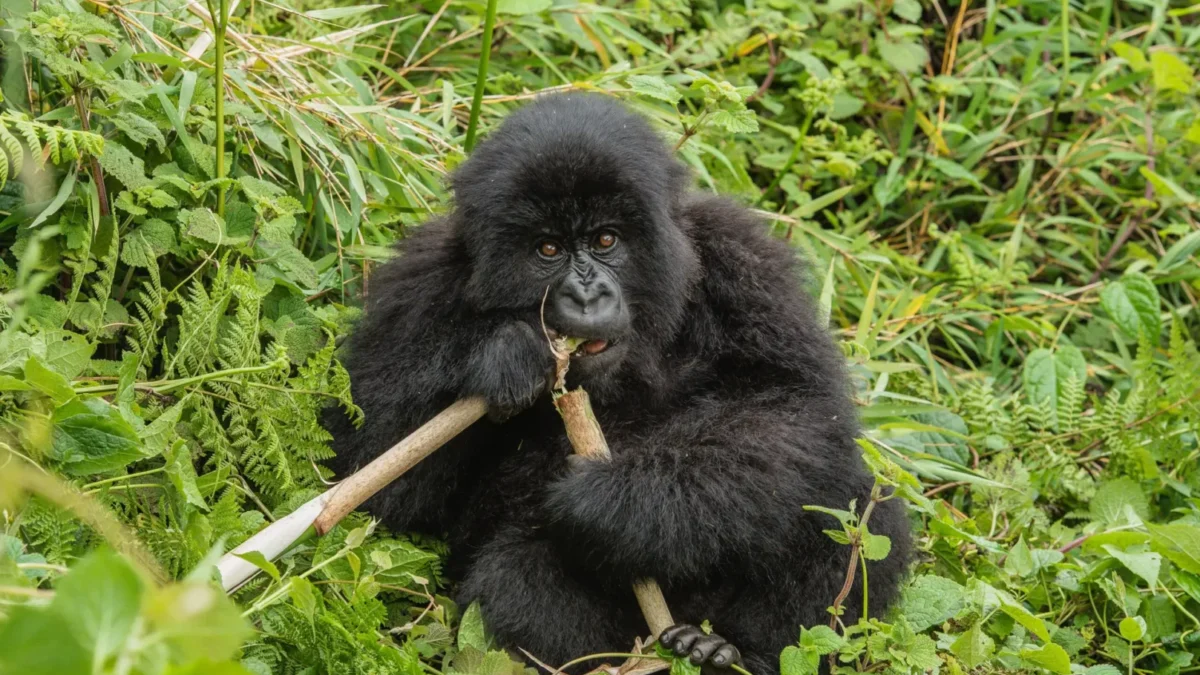
Short Gorilla Tours in Rwanda with Wildlife. If your holiday calendar can’t stretch to two weeks in East Africa, you don’t have to give up on meeting a mountain gorilla face to face. A short gorilla tour in Rwanda — typically two to four days — lets you trek to a wild gorilla family in Volcanoes National Park, then layer in a Big Five wildlife drive, a forest walk, or a lakeside afternoon, all without the long overland distances required in neighboring countries. Rwanda is, quite simply, the fastest and most comfortable place on earth to combine world-class primate trekking with genuine wildlife safari time, and that combination is exactly what this guide is built around.
Below you’ll find a complete breakdown of what a short Rwanda gorilla and wildlife tour actually looks like day by day, what it costs in 2026, the rules the Rwanda Development Board enforces on every trek, and how to fold in Akagera’s lions and rhinos or Nyungwe’s chimpanzees without turning a short trip into a marathon. Wherever it’s useful, we’ve linked out to our own short gorilla trekking tours and to trusted logistics partners on the ground, so you can go from reading to booking in the same sitting.
Why a Short Gorilla Tour in Rwanda Works So Well
Rwanda has an underrated advantage over Uganda and the Democratic Republic of Congo: geography. Volcanoes National Park sits barely two and a half hours by paved road from Kigali International Airport, so a visitor can land in the morning, be in the Virunga foothills by lunchtime, and be trekking gorillas the very next day. Compare that to a six-to-eight-hour drive to Uganda’s Bwindi Impenetrable Forest, and it’s easy to see why time-pressed travelers, honeymooners, and business travelers extending a work trip all gravitate toward Rwanda for a compact, high-impact safari.
That short transfer time is the backbone of every one of our 3-day gorilla trekking tour itineraries: one day gets you into position, one day is dedicated to the trek itself, and the last day can either head back to Kigali or push on to a second wildlife experience. Add a fourth day and you can comfortably fit in Akagera National Park’s Big Five safari or a soak in the crater lakes near Musanze. Nothing about a short Rwanda itinerary feels rushed — it’s simply efficient.
What Makes Rwanda’s Gorilla Trekking Experience Different
Rwanda markets itself as a premium, low-volume, high-value safari destination, and gorilla trekking is the clearest expression of that strategy. Only a limited number of permits are issued per gorilla family per day, group sizes are capped at eight trekkers, and trails in Volcanoes National Park tend to be shorter and less muddy than those in Bwindi, since several habituated families live on the park’s lower, gentler slopes. Rangers and trackers who monitor the gorillas daily radio ahead once a family is located, which keeps the actual search time reasonable even on a tight schedule.
The result is a wildlife encounter that feels intimate rather than crowded: you, seven other trekkers, two armed rangers, and a family of mountain gorillas going about their day a few meters away. For many travelers, that single hour is the reason the whole trip gets booked, and it’s why we build every gorilla habituation experience and standard trek around giving you the maximum possible time with the gorillas rather than on the road.
Volcanoes National Park: Home of Rwanda’s Mountain Gorillas
Every short gorilla tour in Rwanda begins and ends at Volcanoes National Park, a 160-square-kilometer stretch of Afromontane forest draped across five of the eight Virunga volcanoes: Karisimbi, Bisoke, Muhabura, Gahinga, and Sabyinyo. This is the same forest where primatologist Dian Fossey conducted her groundbreaking research in the 1960s and 70s, and her research center, the Dian Fossey Gorilla Fund’s Karisoke office in Musanze, still anchors much of the conservation work that protects these gorilla families today.
Roughly a dozen habituated gorilla families are open to tourism here, ranging from smaller families with a single silverback to sprawling groups of 20 or more individuals. Park rangers assign trekkers to a specific family each morning based on fitness level and preference, so a short two-day visit still gives you a genuine, well-managed encounter rather than a rushed formality.
The Ideal Short Itinerary: 3 Days, 2 Nights Gorilla Trek
For most travelers, three days is the sweet spot: long enough to trek comfortably and see a second attraction, short enough to fit around a busy calendar. Here’s how a typical short gorilla tour in Rwanda breaks down.
Day 1: Arrival in Kigali and Transfer to Musanze
Most itineraries start with a pickup at Kigali International Airport, followed by the scenic drive north through Rwanda’s famous “thousand hills” countryside to Musanze (formerly Ruhengeri), the gateway town to Volcanoes National Park. The drive takes around two and a half to three hours on a well-maintained road, with tea plantations, terraced hillsides, and roadside markets along the way. Travelers arriving from Uganda instead of directly into Kigali often use a dedicated Pick and Transfer Safaris vehicle for this leg, since cross-border road transfers between Kigali and Kisoro or Entebbe are one of their specialties. If you’re combining a Rwanda visit with time in Uganda, it’s worth reading their notes on starting your tour in Kigali and ending in Entebbe before you finalize flights.
Once you check into your lodge near the park, most operators use the afternoon for a briefing on trekking etiquette, gear, and the following morning’s early start. This is also a good time to confirm any add-ons, such as an Akagera or Nyungwe extension, with your safari consultants so the rest of the trip is locked in.
Day 2: The Gorilla Trek Itself
Trekking day starts early, with registration at the park headquarters around 7:00 a.m., where you’re briefed and assigned to a gorilla family. From there, a 4×4 vehicle drives you to the trailhead nearest that family’s last known location, and the walk itself can last anywhere from 30 minutes to three or four hours depending on where the gorillas have moved overnight. Porters are available to carry daypacks and offer a steadying hand on steeper, muddier sections — hiring one is inexpensive and directly supports the local community.
Once your guide spots the family, you leave your walking sticks and bags with the porters and approach quietly, single file. Rwanda strictly limits every group to exactly one hour with the gorillas, which is enough time to watch silverbacks, mothers, and playful juveniles at close range, take photos (without flash), and simply absorb the experience. Afterward it’s a walk back down to the vehicle and a return to your lodge for a well-earned rest.
Day 3: A Wildlife Extension or Return to Kigali
The final day of a short tour is where you decide how “short” you really want to keep things. Travelers on a tight schedule head straight back to Kigali for a flight out or a half-day Kigali city tour, taking in the Kigali Genocide Memorial and the Inema Arts Center on the way. Travelers with one extra day instead push on to Akagera National Park for a Big Five game drive, or detour into Nyungwe Forest for chimpanzee trekking and the canopy walkway — both covered in detail below.
Quick tip: If a straight 3-day trek feels too tight, our 2-day express gorilla safari compresses the itinerary into an overnight trip for travelers arriving and departing through Kigali on consecutive days, while a 4- or 5-day version comfortably adds a full Big Five safari in Akagera.
Adding Akagera National Park: Rwanda’s Big Five Wildlife Safari
Few travelers realize that Rwanda is a genuine Big Five destination. Akagera National Park, roughly two and a half hours east of Kigali, reintroduced lions in 2015 and eastern black rhinos in 2017 after both species had been locally extinct for decades, joining the park’s existing elephant, buffalo, and leopard populations. Akagera’s savanna, lakes, and papyrus swamps also support over 500 recorded bird species, giraffes, zebras, hippos, and enormous Nile crocodiles, making it a completely different ecosystem from the misty bamboo forest of Volcanoes National Park.
Because Akagera sits on the opposite side of Kigali from Musanze, most short tours schedule it as a discrete day trip or overnight extension either before or after the gorilla trek, using Kigali as the hinge point. A full-day game drive typically covers both the northern and southern sectors, with a boat cruise on Lake Ihema as an optional add-on for close-up hippo and crocodile sightings.
Adding Nyungwe Forest: Chimpanzees and Canopy Walks
For travelers who want primates beyond gorillas, Nyungwe Forest National Park is one of Africa’s oldest and most biodiverse rainforests, home to roughly 500 habituated chimpanzees split across several communities, along with 13 other primate species including the striking Ruwenzori colobus, which moves through the canopy in troops of several hundred. Nyungwe’s suspended canopy walkway, one of only a handful in Africa, adds a completely different perspective on the forest than a ground-level trek.
Nyungwe sits in Rwanda’s southwest, roughly five hours from Musanze, so it’s a better fit for a 5-day-plus itinerary than a strict 2- or 3-day gorilla-only trip — but it’s worth flagging here because so many travelers ask whether they can “do it all” in one trip. The honest answer is: yes, with one extra travel day.
A Lake Kivu Add-On for Relaxation
If the goal is to end a short gorilla tour on a slower note, Lake Kivu is roughly a two-hour drive from Musanze and offers lakeside lodges, boat trips to Napoleon Island’s fruit bat colony, and simply a chance to decompress after an early-morning trek. It’s a popular half-day or overnight tack-on for travelers who have a spare day before their return flight and want scenery without another activity-packed itinerary.
Gorilla Trekking Permit Cost in 2026
A gorilla trekking permit issued by the Rwanda Development Board currently costs US $1,500 per person for international visitors, a price that has stayed consistent for several years and reflects Rwanda’s conservation-first, low-volume tourism model. The fee directly funds park management, anti-poaching patrols, and a revenue-sharing program that channels a percentage of tourism income back into communities bordering the park. East African Community citizens and Rwandan residents pay significantly discounted rates.
Permits are limited and often sell out weeks or months in advance during the June-to-September and December-to-February peak seasons, so booking early is essential for any short trip where your travel dates are fixed. Our team tracks availability directly and can confirm our current gorilla permit cost and remaining permit slots before you commit to flights.
Rules and Regulations Every Trekker Must Know
Rwanda’s gorilla trekking program is tightly regulated, and understanding the rules in advance makes trek-day far less stressful. The most important ones: the minimum age for trekkers is 15 years old, groups are capped at eight people per gorilla family, and visitors must stay at least seven meters from the gorillas at all times to protect both parties from disease transmission (gorillas share roughly 98% of human DNA and are susceptible to many of the same respiratory illnesses). Flash photography, eating, and loud talking near the gorillas are prohibited, and anyone showing signs of a cold or contagious illness on trek day may be asked to sit it out.
Porters, walking sticks, and gardening gloves are all worth arranging in advance rather than on the morning of your trek, and a reasonable baseline fitness level matters more than raw hiking experience, since trail conditions depend entirely on where the gorillas happened to wander the night before. On a short itinerary, arriving a day early rather than trekking the same morning you land is also strongly recommended, since flight delays leave zero buffer if your trek is scheduled for the next day and you’re still airborne. We cover every one of these requirements, plus what to do if you need to reschedule a permit due to illness or a missed flight, in our full gorilla trekking rules and regulations guide.
How Gorilla Tourism Protects Rwanda’s Mountain Gorillas
It’s worth understanding why the permit fee is priced the way it is, because the conservation story behind it is part of what makes a short gorilla tour feel meaningful rather than transactional. Mountain gorillas were once projected to disappear entirely by the end of the twentieth century, with the Virunga Massif population dropping to roughly 250 individuals in the 1980s. Decades of anti-poaching patrols, veterinary monitoring, and tourism-funded conservation have reversed that trend so consistently that in 2018 the IUCN reclassified mountain gorillas from Critically Endangered to Endangered — one of the very few great ape success stories on record. The global population today stands at just over 1,000 individuals split between the Virunga Massif (spanning Rwanda, Uganda, and the DRC) and the separate Bwindi-Sarambwe population in Uganda.
Tourism revenue is the engine behind that recovery. A share of every permit fee funds ranger patrols, veterinary care for sick or injured gorillas, and a revenue-sharing scheme that returns a percentage of park income directly to communities living along the park boundary, financing schools, health centers, and clean water projects. Choosing a short, well-run gorilla tour over an unregulated or informal encounter isn’t just the safer option for you — it’s a direct, measurable contribution to a conservation program that is actually working. You can read more about how we work with local communities and conservation partners on our locally based team’s page.
Best Time of Year for a Short Gorilla Tour
Rwanda’s gorilla trekking is open year-round, but conditions vary. The two dry seasons — roughly June through September and December through mid-February — offer firmer trails and lower rainfall, making them the most popular (and most heavily booked) windows for a short trip where you can’t afford a rained-out trek. The long and short rainy seasons (March to May and October to November) bring lusher scenery, fewer crowds, and occasionally discounted rates, at the cost of muddier, more demanding trails. For a full breakdown by month, including which season pairs best with an Akagera extension, see our guide to the best time to go gorilla trekking in Rwanda.
What to Pack for a Short Gorilla and Wildlife Trip
Because a short itinerary leaves little room for error, packing smart matters. The essentials are sturdy waterproof hiking boots, a lightweight rain jacket, long trousers and long sleeves tucked into boots and gloves (the forest’s stinging nettles are notorious), a daypack, insect repellent, and a good pair of binoculars for both the gorilla trek and any wildlife drive in Akagera. Cash in small denominations is useful for tipping porters, rangers, and drivers, since card payments are rarely practical in and around the park. Our detailed packing list for gorilla trekking breaks this down by season and by whether you’re adding a savanna safari to the itinerary.
Total Budget for a Short Gorilla Tour: What to Expect Beyond the Permit
The US $1,500 permit is the headline cost, but it isn’t the whole budget. On top of it, expect to pay for accommodation (anywhere from roughly $150 a night at a comfortable mid-range lodge to well over $1,000 a night at an ultra-luxury property overlooking the volcanoes), private ground transport with a driver-guide, meals not included at your lodge, porter and ranger tips, and travel insurance that specifically covers trekking activities. A realistic all-in budget for a 3-day, 2-night short gorilla tour — permit, mid-range lodging, transport, and meals — typically lands somewhere between $2,200 and $3,500 per person, with luxury properties pushing that figure considerably higher.
Booking permit, lodging, and transport as a single package rather than piecing them together separately is usually both cheaper and far less stressful on a short timeline, since your operator absorbs the coordination risk if a flight shifts or a permit needs to be reissued. It’s one of the main reasons travelers on a tight schedule book through an established local operator rather than assembling a DIY itinerary from separate suppliers at the last minute.
Where to Stay Near Volcanoes National Park
Accommodation near Musanze ranges from comfortable mid-range lodges to some of Africa’s most exclusive luxury properties, several of which offer direct views of the Virunga volcanoes from private decks. For a short trip, proximity to the park headquarters in Kinigi matters more than almost any other factor, since trek-day departures start early and a shorter drive means more sleep. We match accommodation to trip length and budget as part of every Rwanda safari package we design, rather than defaulting to a single fixed lodge for every traveler.
Getting to Rwanda and Arranging Transfers
Kigali International Airport is served by direct and connecting flights from major hubs in Europe, the Middle East, and across Africa, and Rwanda’s e-visa system makes arrival straightforward for most nationalities, with many travelers eligible for a visa on arrival or a fast-tracked online application processed within a few working days. For a short itinerary where every half-day counts, sorting your visa before departure rather than at the airport counter removes one more variable from an already tight schedule. If your trip also touches Uganda — a common pairing for travelers who want to compare Bwindi and Volcanoes National Park, or who are flying in or out of Entebbe — ground transfers between the two countries are entirely manageable in a single day with the right operator. Services like reliable Kigali airport transfers and cross-border transfer service between Uganda and Rwanda handle exactly this logistics gap, including the paperwork and border-crossing steps that first-time travelers often find confusing.
Travelers extending into Uganda after their Rwanda gorilla trek can also arrange a Bwindi-to-Kigali road transfer, useful for anyone doing a “double gorilla trek” that combines both countries’ habituated families in one longer trip, or simply looking to compare the two experiences.
Combining Rwanda and Uganda in One Trip
Because Volcanoes National Park sits close to the Uganda border, a growing number of travelers combine a short Rwanda gorilla tour with a few days across the border in Bwindi Impenetrable Forest or Mgahinga Gorilla National Park, effectively doubling their gorilla trekking chances on a single trip. If you’re weighing that option, it’s worth reading up on what to do after a gorilla tour in Bwindi, since the onward logistics — and border crossing timing — differ depending on which direction you’re traveling. Travelers overnighting near the border before crossing often stay at properties like the Ikoro Hotel in Kisoro, a convenient staging point on the Uganda side.
For the Rwanda-to-Uganda direction, arranging a car hire with a driver-guide who knows both sides of the border removes most of the friction, and some operators can even offer help securing a gorilla permit on the Uganda side if you decide to extend your trip once you’re already in the region. Flying out through Entebbe instead of Kigali is straightforward too, with a dedicated Entebbe Airport pick-up waiting at the end of the drive; you can read more about their approach to cross-border logistics on their experienced transfer team’s page.
Booking Your Short Gorilla Tour: What to Expect From Us
We design every itinerary around the traveler’s actual time budget rather than pushing a one-size-fits-all package, which is why our shortest trips run as tight as two days and our most popular sits at three. Every quote includes permit sourcing and confirmation, private 4×4 transport with an experienced driver-guide, accommodation matched to your budget, and a single point of contact for the whole trip. You can browse our full range of Rwanda safari packages, read reviews from past travelers, or check our gorilla trekking FAQs for answers to the questions we get asked most often before reaching out.
Because permits are limited and sell out fastest during peak months, the single most useful thing you can do if you’re serious about a short gorilla tour is to lock in your trekking date before finalizing flights. Contact our safari consultants with your preferred travel window, and we’ll confirm permit availability, build a day-by-day itinerary around it, and handle every transfer from the moment you land to the moment you fly out. Learn more about our locally based team and why so many short-trip travelers choose to trek with us.
Frequently Asked Questions About Short Gorilla Tours in Rwanda
Is two or three days really enough time? Yes. A 2-day trip covers a single gorilla trek with a same-day or next-day departure, while three days adds breathing room for travel delays and one extra half-day activity, such as a Kigali city tour or a Lake Kivu afternoon.
Can I combine gorilla trekking with a Big Five safari on a short trip? Yes, if you allow four to five days total. Akagera National Park is close enough to Kigali to fold into even a compact itinerary without doubling your trip length.
Do I need to be extremely fit? No, but a reasonable baseline fitness level helps, since trail difficulty depends on where the gorilla family is located that morning. Porters are available to assist on steeper sections.
What is the minimum age for gorilla trekking in Rwanda? Fifteen years old, a rule strictly enforced by the Rwanda Development Board at every trailhead.
How far in advance should I book a permit? For peak season travel (June–September and December–February), two to three months’ notice is strongly recommended, since permits per family are limited and sell out early.
What happens if it rains on trek day? Treks go ahead regardless of weather — Volcanoes National Park is a rainforest, so light rain is normal. A waterproof jacket and rain cover for your daypack are usually enough; trekking is only ever cancelled for the rangers’ own safety assessment of the terrain, which is rare.
Can I extend a short gorilla tour if I decide I want more time once I’m in Rwanda? In most cases, yes, provided permits and accommodation are still available. Because short itineraries are built to be modular, adding an Akagera day or a Lake Kivu night after arrival is usually just a matter of availability rather than a full itinerary rebuild — another reason to book through an operator who can adjust on short notice rather than a fixed, pre-paid package.
Ready to Trek? Book Your Short Rwanda Gorilla Safari
A short gorilla tour in Rwanda proves that you don’t need two weeks and a complicated overland route to have a genuine, once-in-a-lifetime wildlife encounter. Two to four days, the right permit secured early, and a team that handles the transfers and logistics is all it takes to stand a few meters from a wild silverback gorilla and still make it home on schedule. Whether you’re adding a Big Five safari in Akagera, a chimpanzee trek in Nyungwe, a lakeside afternoon on Lake Kivu, or simply flying in and out for the gorillas alone, we’ll build the itinerary around your calendar rather than asking you to fit your calendar around ours.
Rwanda has spent the last three decades turning a fragile, nearly-lost population of mountain gorillas into one of conservation’s clearest success stories, and a short, well-planned trek lets you witness that recovery firsthand without sacrificing the rest of your travel plans. Get in touch today, tell us your travel window, and let’s start planning your short gorilla and wildlife tour.